
Digital twin based optimisation of Rydberg Atom QPUs

Abstract
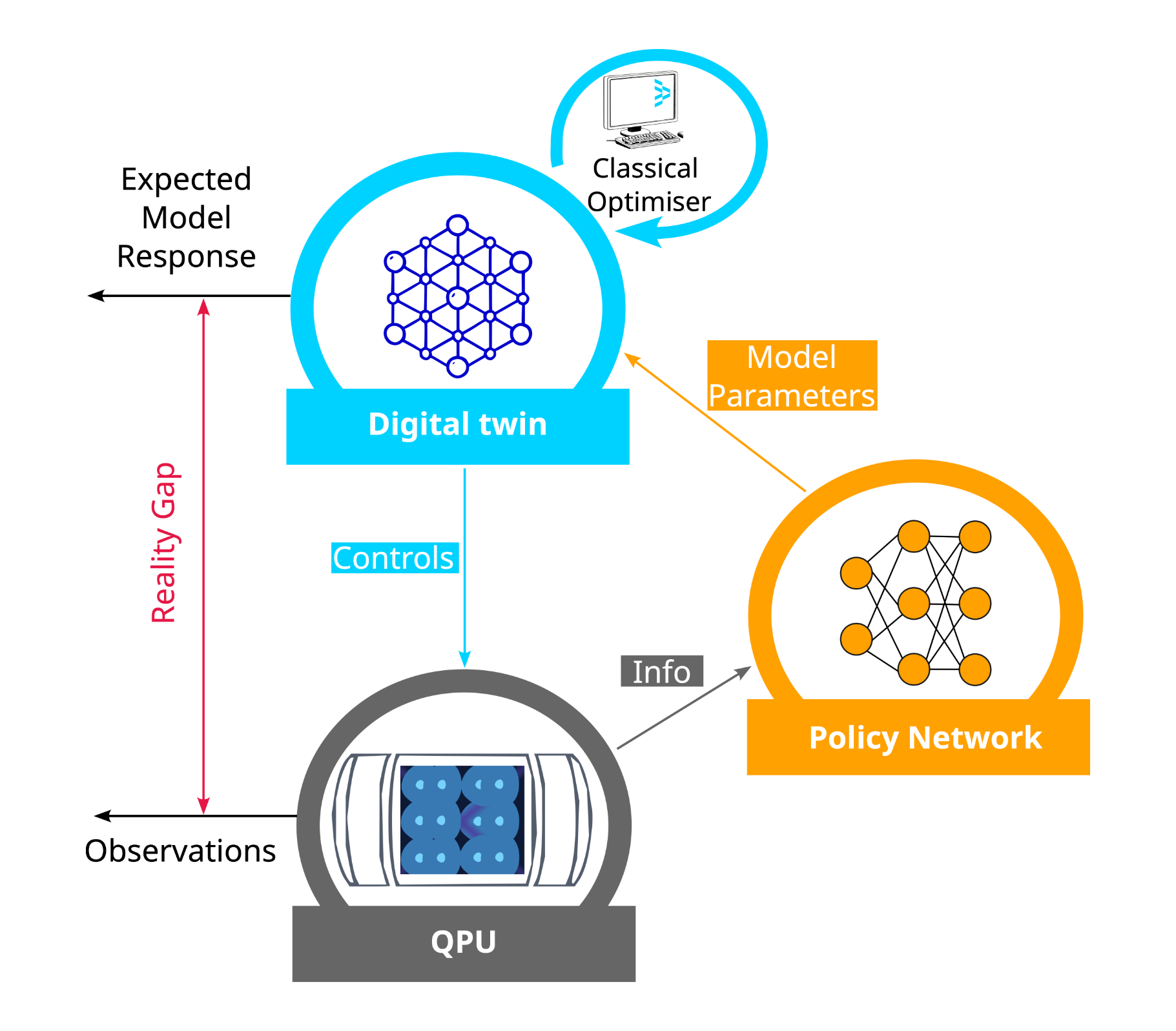
Neutral atoms are a leading platform for scalable quantum computing, offering long coherence times and precise optical control. Achieving reliable, high-fidelity gates, however, remains challenging due to technical noise, motional effects, and hardware imperfections. We present an automatic-differentiable digital twin that models atomic quantum systems with high physical accuracy and efficiently simulates qubit gate dynamics, including realistic effects such as laser phase noise and probe-induced shifts. By integrating quantum optimal control and benchmarking techniques within this differentiable framework, we enable rapid, gradient-based optimisation of gate performance and robustness. Demonstrations on both neutral-atom and trapped-ion platforms show substantial improvements in simulated and experimental fidelities. Importantly, our approach enables fast and robust calibration of neutral-atom gates using only a minimal number of experimental measurements, thereby paving the way for scalable, closed-loop optimisation in large-scale quantum processors.
Slides are available online here.
Authors:
Marco Rossignolo (Qruise)
Tobias Olsacher (Forschungszentrum Jülich)
Lorena Bianchet (Qruise)
Andrea Alberti (Max Planck Institute of Quantum Optics)
Interested in learning more about this research or discussing potential applications?