
Application of optimal control theory in spectral-spatial RF pulse design

Abstract
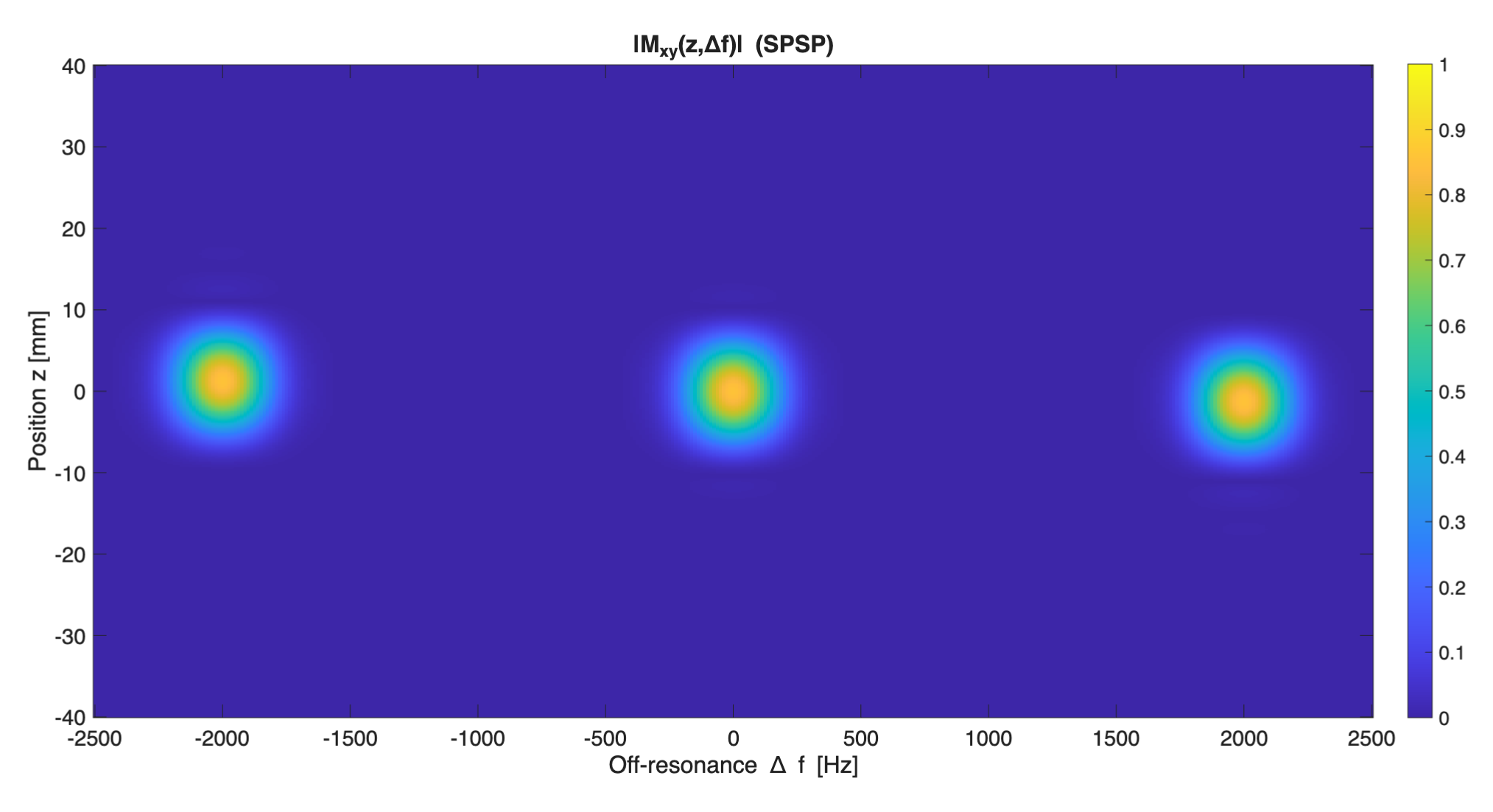
Spectral-spatial (SPSP) radio-frequency pulses are essential for selective excitation in magnetic resonance imaging, particularly in hyperpolarised ¹³C studies where spatial and chemical shift localisation must be achieved simultaneously. We present an optimal-control framework, implemented within the the Qruise differentiable physics simulation platform, for the design and simulation of SPSP pulses under realistic hardware constraints. The optimisation minimises magnetisation profile error in the joint spectral-spatial domain while enforcing amplitude, slew-rate, and gradient-raster limitations. The framework integrates Bloch or Schrödinger equation simulations and differentiable optimisation, enabling generation of robust, hardware-aware pulse shapes. Initial results demonstrate uniform excitation for single-band targets, with ongoing efforts to enhance spectral and spatial selectivity as well as time efficiency. This approach provides a flexible foundation for real-time, optimally controlled SPSP pulse design in metabolic and multinuclear MRI applications.
Slides are available online here.
Authors:
Mehrdad Alinaghian Jouzdani (Qruise)
Swathi Hegde (Qruise)
Alastair Marshall (Qruise)
Yousof Mardoukhi (Qruise)
Shai Machnes (Qruise)
Interested in learning more about this research or discussing potential applications?