

Qruise launches revamped QruiseML for faster modelling and optimisation in the quantum error correction era
16. September 2026
New Julia-backed simulation engine more than 4 times faster and significantly more memory efficient
Saarbrücken, Germany | Wednesday September 16th, 2026 – Qruise has released the latest version of its digital twin software, QruiseML. While the previous JAX-based version performs well for smaller simulations, computational demands increase rapidly as system size grows. With quantum computing moving towards the fault-tolerant era, simulations need to encompass entire error correction unit cells rather than only a few coupled qubits and their nearest neighbours. The latest version of QruiseML fills this need with a more scalable approach to quantum system modelling.
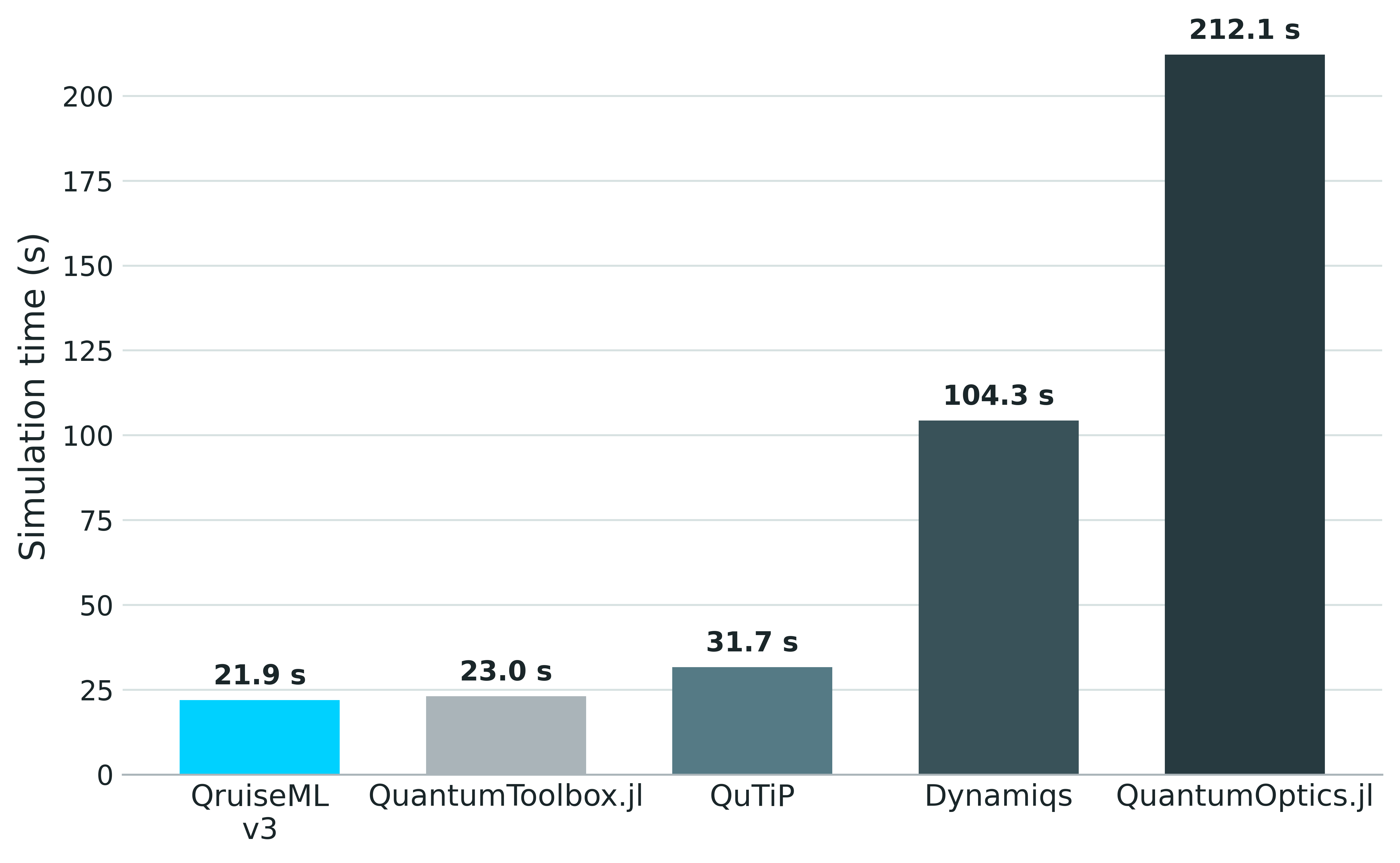
At its core is a completely rewritten version of qruise-toolset, the simulation engine that powers QruiseML. The new version still provides a Python interface that scientists use to build and test their models, including support for familiar representations such as QuTiP objects, with the underlying computation handled in Julia. This delivers substantial performance improvements, reducing memory consumption and enabling significantly faster simulations of much larger quantum systems. Early benchmarks on standard desktop-class CPUs for 16-qubit states show a 4.8x and 1.5x speed-up compared to Dynamiqs and QuTiP, respectively. Automatic differentiation remains central to QruiseML, enabling efficient model learning and quantum optimal control without requiring users to work with dedicated differentiation frameworks such as JAX.
The newest QruiseML version also comes with comprehensive documentation to get users up and running easily, with dedicated Building blocks pages explaining each component and how to use it. For those who prefer a more hands-on learning experience, a series of example notebooks guides users through building a model of their system, running simulations, and performing quantum optimal control.
Stay informed with our newsletter
Subscribe to our newsletter to get the latest updates on our products and services.